Mercury at the cape : Friendship 7, Aurora 7, Sigma 7
Three orbital Mercury missions launched from Cape Canaveral in 1962: John Glenn on February 20, Scott Carpenter on May 24, Wally Schirra on October 3. The cape became the address of American spaceflight.
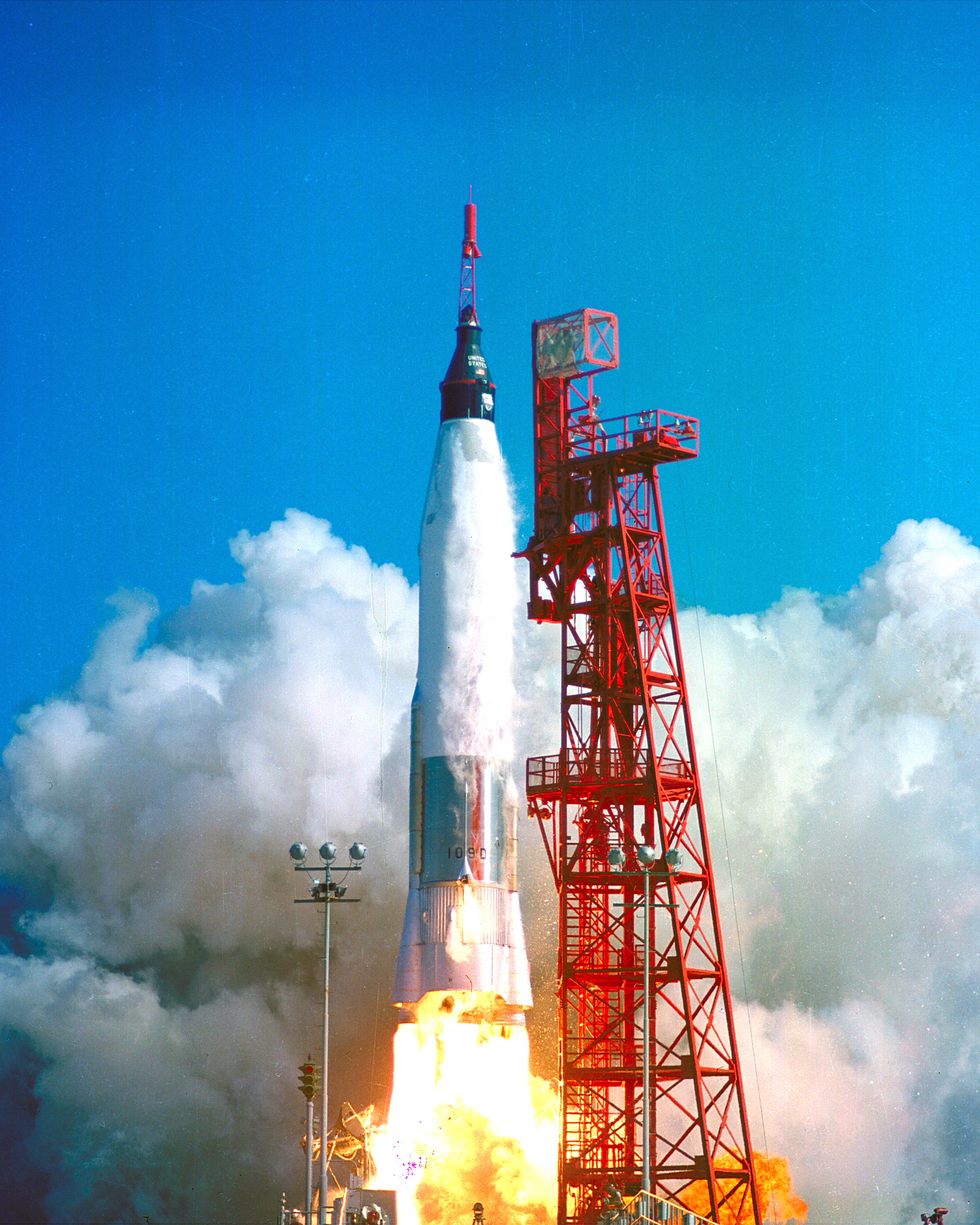
Three Mercury missions flew from Cape Canaveral in 1962. John Glenn lifted off on February 20 from Launch Complex 14, orbited Earth three times in 4 hours 55 minutes, and splashed down 800 miles southeast of Bermuda. Scott Carpenter followed on May 24, orbited three times, overshot his recovery zone by 250 miles, and was missing for an hour before Navy helicopters reached him. Wally Schirra launched on October 3, orbited six times in 9 hours 13 minutes, and landed within 5 miles of the recovery carrier. The three flights effectively closed the question of whether Americans could match the Soviet orbital capability. They also fixed Cape Canaveral as the public face of US human spaceflight, eclipsing for the rest of 1962 the Vostok launches that had preceded them.
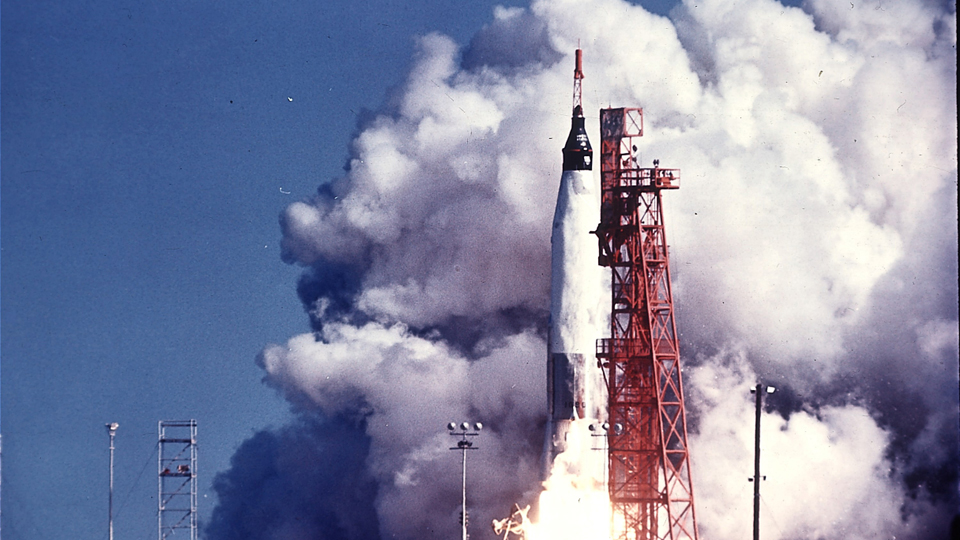
Friendship 7 : February 20, 1962
John Glenn’s launch had been scheduled and scrubbed ten times between January 23 and February 20. Weather caused most of the scrubs. A leaking fuel tank caused one. The cumulative delay had stretched into international news. The Soviets had already orbited Yuri Gagarin (April 1961) and Gherman Titov (August 1961). The pressure on NASA was enormous.
The launch on the 20th went smoothly. The Mercury-Atlas 6 vehicle (an Atlas LV-3B booster with the Mercury capsule designated Friendship 7) lifted off at 9:47 AM EST. Glenn reached orbit at 100 nautical miles altitude, inclined 32.5 degrees to the equator. His orbital period was 88 minutes 29 seconds. He completed three orbits in 4 hours 55 minutes 23 seconds.
The mission’s most-remembered moment came partway through the second orbit. Glenn radioed: “This is Friendship Seven. I’ll try to describe what I’m in here. I am in a big mass of some very small particles that are brilliantly lit up like they’re luminescent.” The “fireflies,” as he called them, were eventually identified as frozen water vapor and paint chips drifting off the capsule.
The other tense moment came near the end of the flight. Mission Control received a telemetry signal suggesting the capsule’s heatshield was loose. If true, the heatshield would tear off during reentry and the capsule would burn. The controllers decided to retain the retrorocket package after retrofire, hoping its straps would hold the heatshield in place. Glenn was told to keep the package on but not why. The signal turned out to be a false telemetry reading. The heatshield was fine. The strap-retention decision was unnecessary but not harmful.
Glenn splashed down at 14:43 EST, 800 miles southeast of Bermuda. The destroyer USS Noa picked him up 21 minutes later.
Aurora 7 : May 24, 1962
Scott Carpenter’s launch was less dramatic on the pad and more dramatic in flight. Mercury-Atlas 7 lifted off at 7:45 AM EST on May 24, 1962, again from LC-14. The mission was scheduled to mirror Glenn’s: three orbits, similar inclination, similar duration.
Carpenter spent more time on science observation and photography than Glenn had. He fired the maneuvering thrusters extensively to position the capsule for camera angles. By the third orbit, his fuel reserves for attitude control were running short.
The retrofire sequence at end of mission required precise attitude control. Carpenter was tasked with manually positioning the capsule because the automatic attitude control system was running low on fuel. He didn’t get the alignment quite right. Retrofire happened 3 seconds late, and the capsule’s pitch was about 25 degrees off the intended angle. The combined errors put Carpenter’s splashdown point about 250 nautical miles past the planned recovery zone.
When the capsule hit the water at 12:41 PM EST, no recovery ship was in sight. Radio contact was lost for about 40 minutes. NASA’s worst public-information moment of the Mercury program followed: TV networks broadcast that Carpenter was missing while the recovery aircraft scrambled to find him.
A P2V Neptune patrol plane spotted the capsule and Carpenter in a life raft about an hour after splashdown. He was uninjured. The destroyer USS Pierce picked him up three hours later.
The cape press corps was furious. The recovery delay made NASA look incompetent. The agency reviewed Carpenter’s flight data and concluded that the overshoot was within design tolerances for a Mercury mission, but the public perception was that he had been lost in space. Carpenter never flew again. He transferred to the Navy’s deep submergence program in 1963.
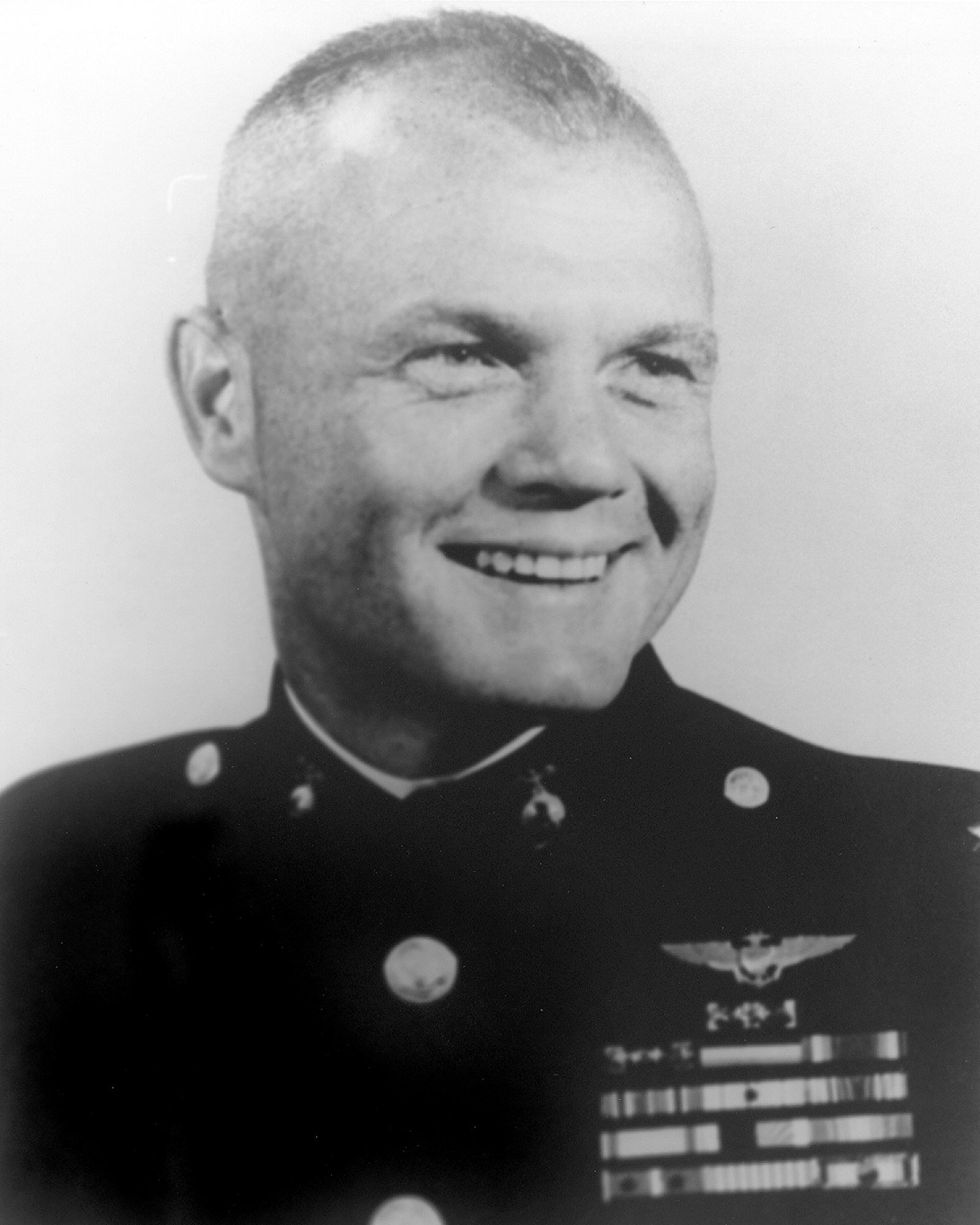
Sigma 7 : October 3, 1962
Wally Schirra’s mission was specifically designed to be the precise opposite of Aurora 7. The mission name, Sigma (the engineering symbol for summation), was Schirra’s deliberate signal that this would be a textbook mathematical flight. Schirra was a Navy test pilot temperamentally suited to precision flying. He had been critical of Carpenter’s freelancing approach.
Mercury-Atlas 8 lifted off at 7:15 AM EST on October 3, 1962, from LC-14. Schirra’s mission was six orbits, double Glenn and Carpenter’s three. The longer mission tested whether Mercury’s life support could handle the extended duration, which was critical data for the planned MA-9 mission the following year.
Schirra flew it conservatively. He used less than half the maneuvering fuel Carpenter had used. He stayed in chimp mode (his term) for most of the mission, letting the automatic systems do the work and intervening minimally. He took photographs, made the planned medical observations, and reported the orbital experience in clipped Navy test-pilot prose that made for less compelling broadcasting than Glenn’s awe but better post-flight engineering data.
Splashdown was at 4:28 PM EST in the Pacific, 275 nautical miles northeast of Midway Island. The aircraft carrier USS Kearsarge picked him up 40 minutes later, 5 nautical miles from the planned recovery point. The accuracy was specifically the point.
Schirra’s flight was the rebuttal to Aurora 7. NASA could fly precision missions of long duration. The path to Gemini and Apollo was open.
The cape’s 1962 transformation
The three Mercury launches turned Cape Canaveral into a household name. Glenn’s flight on February 20 was watched live by an estimated 100 million Americans, the largest live television audience to that date. The cape’s name went from obscure military installation to American place-name. Cocoa Beach motels filled with reporters. The Cape Kennedy press site (then still called Cape Canaveral) became a regular dateline.
The other Mercury crewed flights were Alan Shepard’s suborbital MR-3 on May 5, 1961, Gus Grissom’s suborbital MR-4 on July 21, 1961, and Gordon Cooper’s MA-9 on May 15, 1963. All six Mercury crewed missions launched from the cape: MR-3 and MR-4 from LC-5, the four orbital missions from LC-14.
LC-5 is gone (it was demolished in the late 1960s). LC-14 is a designated National Historic Landmark and includes a memorial garden to the Mercury Seven. The site is on Cape Canaveral Space Force Station land and accessible only via official tour.
What 1962 proved
By the end of 1962, the United States had matched the Soviet orbital flight capability and exceeded the Soviet flight duration (Sigma 7’s nine hours beat Vostok 2’s 25 hours, but in the orbital-per-mission count the US was now at four to the Soviets’ four). The space race had stopped being a one-sided Soviet rout.
It also fixed Cape Canaveral’s identity for the next decade. The cape was where Americans went to space. Every Mercury, every Gemini, every Apollo would fly from this peninsula. The lighthouse stood about three miles south of LC-14. The keepers, who had been moved off the cape in 1949, were still alive to watch the launches from Cocoa Beach.