1961 : The Bay of Pigs and the case for Mercury
John F. Kennedy was inaugurated January 20, 1961. The Bay of Pigs invasion failed April 17. Yuri Gagarin orbited April 12. The case for accelerated American spaceflight was made that spring.
Three events between January and May 1961 set the political conditions for the cape’s Apollo era. John F. Kennedy was inaugurated on January 20, 1961. Yuri Gagarin orbited Earth on April 12, 1961, becoming the first human in space. The Bay of Pigs invasion failed on April 17, 1961, when CIA-trained Cuban exiles were defeated by Castro’s forces in 72 hours. Kennedy gave his “before this decade is out” speech to a joint session of Congress on May 25, 1961, committing the United States to landing a man on the moon by 1970. The cape was the place where that commitment would be physically tested. Mercury was already running. Apollo was about to be conceived in response to a strategic embarrassment.
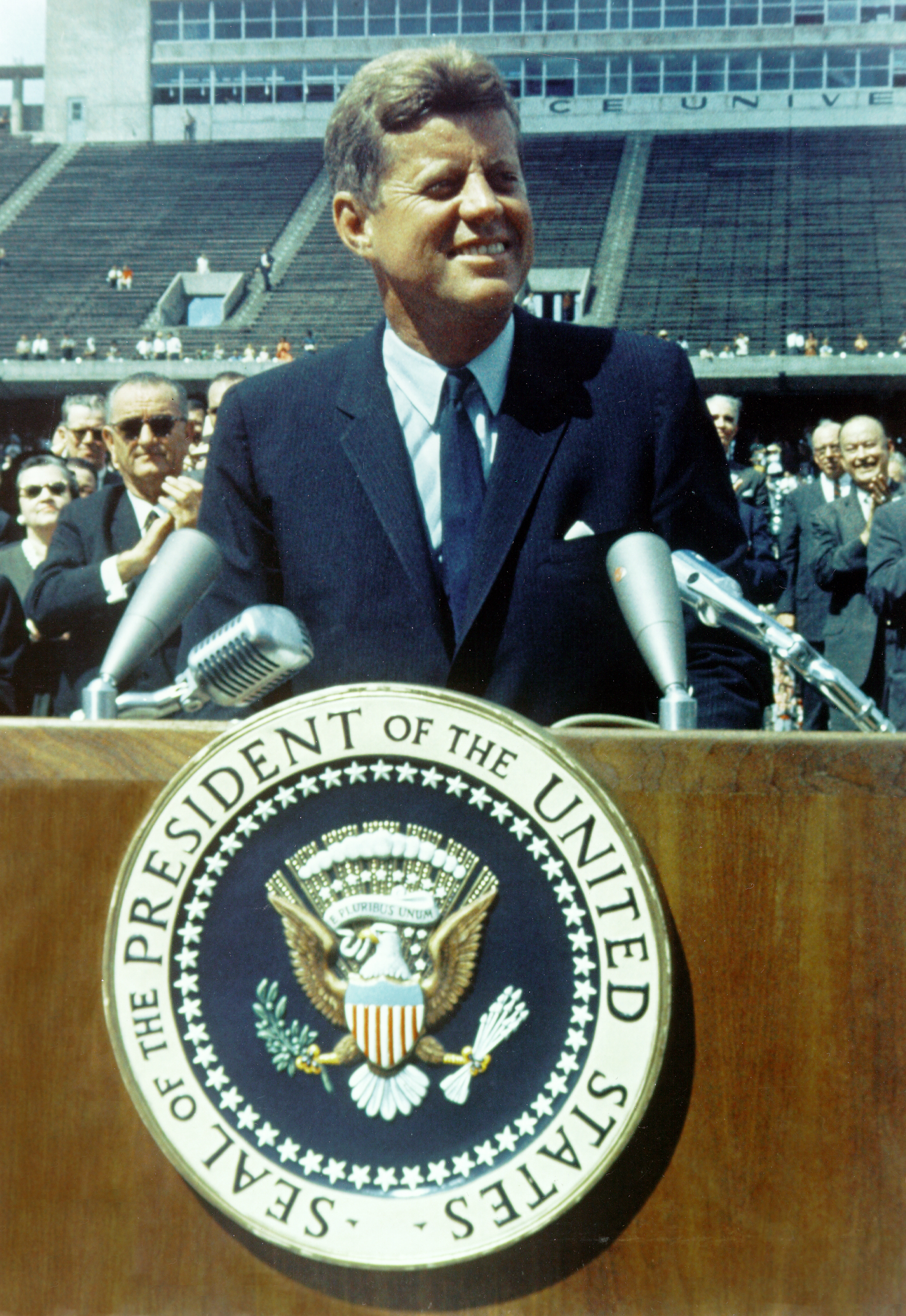
January 20, 1961 : the inauguration
Kennedy’s inaugural address, the most-quoted American inaugural of the 20th century, included two passages relevant to spaceflight. The first was the famous “ask not” line about civic responsibility. The second, less remembered, was about the Cold War’s stakes: “Let every nation know, whether it wishes us well or ill, that we shall pay any price, bear any burden, meet any hardship, support any friend, oppose any foe to assure the survival and the success of liberty.”
Kennedy’s specific space program plans on inauguration day were modest. He had inherited the Eisenhower administration’s Mercury program, which was running but had not yet flown a crewed orbital mission. He had inherited an Air Force ballistic missile development program. He had inherited NASA, established in 1958. None of this involved a moon-landing commitment.
His Vice President, Lyndon Johnson, was a strong space advocate. Johnson had chaired the Senate Preparedness Subcommittee during the post-Sputnik panic of 1957-1958 and was politically invested in American space achievement. Kennedy, less personally invested, was politically receptive.
April 12, 1961 : Gagarin
Yuri Gagarin’s flight aboard Vostok 1 on April 12, 1961, was a strategic shock. The Soviets had:
- Launched the first artificial satellite (Sputnik 1, October 4, 1957)
- Launched the first dog in space (Sputnik 2, November 3, 1957)
- Photographed the far side of the moon (Luna 3, October 4, 1959)
- Sent a probe to Venus (Venera 1, February 12, 1961)
- Put the first human in orbit (Vostok 1, April 12, 1961)
The cumulative pattern was unmistakable: the Soviets were ahead in space, and the gap was widening rather than closing. Mercury, the American program, had not yet flown a crewed orbital mission. The first American suborbital flight (Alan Shepard, May 5, 1961) was still three weeks away.
The April 12 reaction in Washington was intense. Kennedy received a memo from Johnson on April 20 (eight days after Gagarin’s flight) titled “Evaluation of Space Program.” The memo identified four specific space objectives where the US could potentially beat the Soviets: a manned lunar landing, a manned lunar circumnavigation, a robotic Mars probe, and a permanent space station. The moon landing was identified as the most likely to be achievable on a competitive timeline.
April 17, 1961 : the Bay of Pigs
The Bay of Pigs invasion launched in the early morning of April 17, 1961, with about 1,400 CIA-trained Cuban exile soldiers landing at Playa Girón on Cuba’s southwest coast. The operation was supposed to overthrow Fidel Castro’s government, which had taken power in January 1959 and aligned with the Soviet Union.
The operation collapsed in 72 hours. Castro’s forces, numerically superior and forewarned, destroyed the exile brigade. Approximately 100 exile soldiers were killed. Approximately 1,200 were captured. Of the 1,200 captives, most were eventually ransomed back to the United States in late 1962 for $53 million in food and medicine.
The failure was a Kennedy administration disaster. The CIA’s intelligence was wrong. The Air Force air support was inadequate. The Cuban exile assumption that a popular uprising would support the invasion was incorrect. The operation made the Kennedy administration look both incompetent and aggressive at the same time.
Kennedy accepted public responsibility on April 21: “There’s an old saying that victory has 100 fathers and defeat is an orphan.” But the political damage was real. Kennedy’s approval rating in the immediate post-Bay-of-Pigs period dropped from 78 percent to 61 percent (still high, but the trajectory was unmistakable).
The strategic context
By late April 1961, Kennedy faced a specific strategic problem. The Soviets had clear lead in space. The United States had just lost a small war 90 miles from Florida. The Berlin crisis was building toward what would become the 1961 wall and the 1962 missile crisis. The administration needed a high-visibility American achievement to demonstrate that the Cold War was not, in fact, being lost.
A moon landing was the answer Johnson’s April 20 memo had identified. It would be visible, dramatic, technically demanding, and (critically) achievable on a Kennedy administration timeline. The Soviet space program was ahead, but the moon landing required new vehicles, new propulsion, new mission profiles that nobody had built yet. The race was not a continuation of the Vostok-vs-Mercury rivalry; it was a new race that started, in principle, at zero.
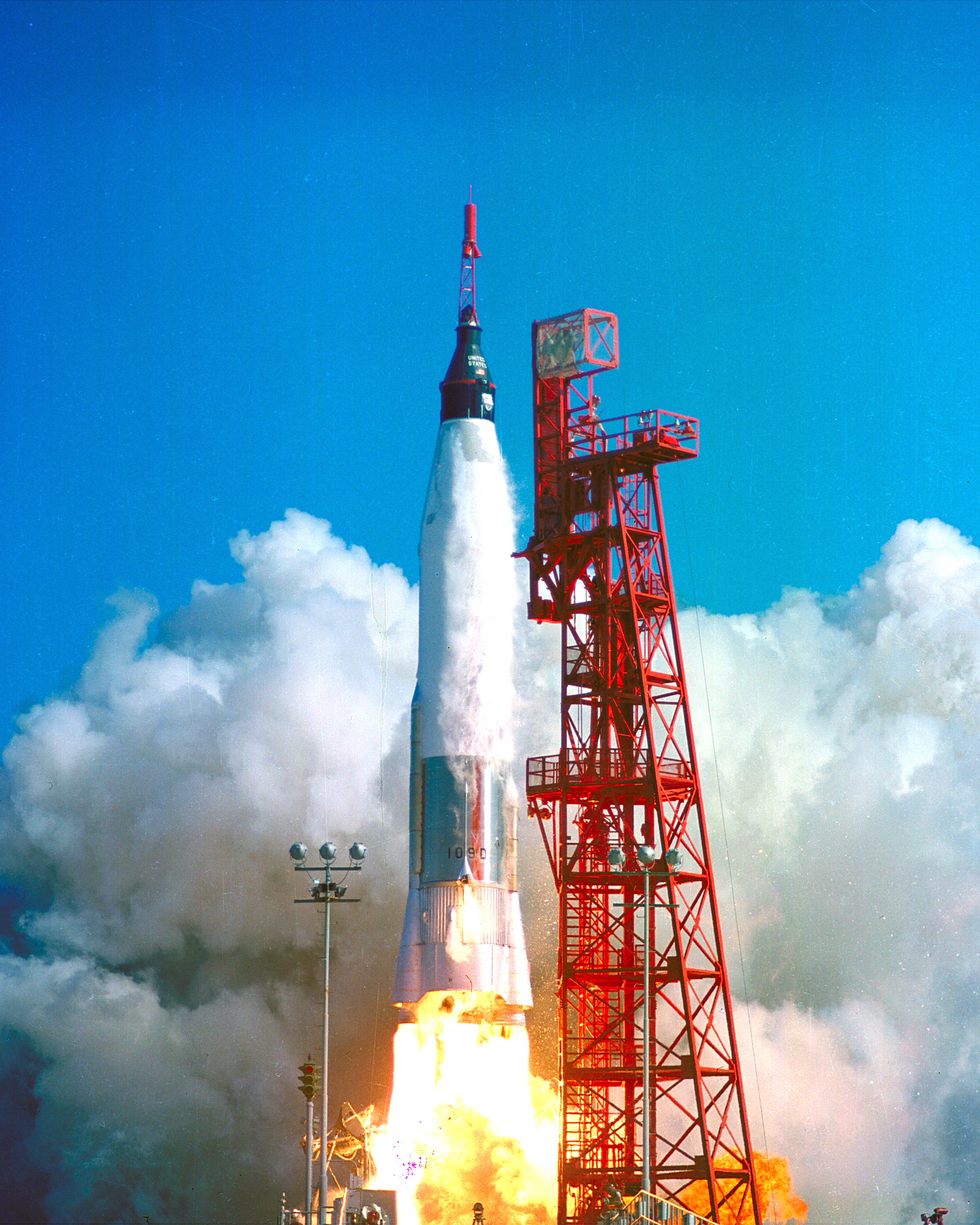
The cape was where this race would happen. Mercury was already running from Launch Complex 14. Apollo would require larger pads (eventually LC-34 and the new LC-39 at Kennedy Space Center). The infrastructure decisions to support a moon program were made in the second half of 1961.
May 25, 1961 : the speech
Kennedy’s “before this decade is out” speech to a joint session of Congress on May 25, 1961, was the public commitment. The relevant passage:
“I believe that this nation should commit itself to achieving the goal, before this decade is out, of landing a man on the moon and returning him safely to the earth.”
The speech was carefully worded. The commitment was the moon, not the space program generally. The deadline was 1970 (which Kennedy hoped would be his second-term watershed). The metric was return-trip success, not just one-way.
The speech also committed specific budget: about $7 billion to $9 billion over five years, in 1961 dollars, scaled across NASA, DOD, and the Atomic Energy Commission. This was a significant federal commitment in an era of much smaller federal budgets. The actual Apollo cost would come in at about $25.4 billion through 1973, in then-year dollars, roughly $260 billion in 2024 dollars.
What this meant for the cape
The May 25 speech effectively created the cape’s Apollo era. NASA’s Launch Operations Center on Merritt Island was established in 1962 specifically to support Apollo. The Vehicle Assembly Building, Launch Complex 39, the crawler-transporters, the Saturn V infrastructure were all funded under the Apollo commitment.
The cape grew. Brevard County population, which had been about 23,000 in 1950, reached 230,000 by 1970, primarily on Apollo employment. Cocoa Beach, Cape Canaveral the city, and Titusville all experienced explosive growth.
The Mercury program continued through 1963 (Cooper’s Faith 7 flight on May 15-16, 1963, was the last Mercury mission). Gemini followed in 1965-1966 (covered in a separate article). Apollo’s first crewed flight, Apollo 1, was scheduled for February 21, 1967, but the pad fire on January 27 killed Grissom, White, and Chaffee at LC-34. The redesigned Apollo program returned to flight in October 1968.
Apollo 11 landed on the moon on July 20, 1969, six and a half months before Kennedy’s “decade” deadline. The commitment from May 25, 1961, was kept.
What 1961 teaches about the cape
The cape’s Apollo identity was made in three months of political crisis. Without Gagarin’s flight, without the Bay of Pigs, without Kennedy’s specific decision to respond with a moon commitment, the cape would not have hosted Saturn V launches. The cape’s specific facilities (LC-39, the VAB, the crawlers) exist because of the May 1961 decision.
This is the cape’s pattern. The cape is a function of strategic decisions made elsewhere. The 1949 JLRPG decision was about Cold War missile testing. The 1961 Apollo commitment was about post-Sputnik national prestige. The 1972 Shuttle decision was about post-Apollo program structure. The 2014 SpaceX lease at LC-39A was about commercial spaceflight policy. Each strategic shift has reshaped what the cape does without changing where the cape is.
The lighthouse keepers in 1894 could have seen all this coming. The same coastline. The same beach. Different rockets.